Excavation vs. In Situ Soil Mixing: Choosing the Right Approach for PRBs and Barrier Walls
By: Paul Lear, Ph.D.When it comes to groundwater containment, the right approach can make or break your remediation plan. Should you remove the native material within the alignment or mix reagents into the native soil? This blog compares excavation and in situ soil mixing for installing permeable reactive barriers (PRBs) and hydraulic barrier walls, helping you make informed decisions under budget and compliance pressures.
Why Containment Matters
PRBs and barrier walls are critical for controlling contaminant migration and meeting regulatory cleanup goals. Choosing the right installation method impacts:
- Cost: Disposal, backfill, and transportation expenses.
- Schedule: Project timelines and risk of delays.
- Compliance: Ability to meet stringent performance criteria.
Excavation: The Traditional Approach
Excavation is the most established method for constructing PRBs and barrier walls. It is typically used when the treatment zone is shallow, well-defined, and straightforward to access. By physically removing contaminated soil and replacing it with clean backfill or engineered barrier materials, it offers immediate visual confirmation of progress. However, those benefits often come with high cost, logistical effort, and surface disruption.
Advantages
- Immediate and complete removal of contaminated material, which can simplify regulatory reporting.
- Highly predictable performance, especially in shallow or well-defined source zones.
Limitations:
- High disposal, transportation, and backfill costs, especially when soil characterization is complex or volumes are underestimated.
- Significant surface disturbance, creating added restoration needs at industrial or developed sites.
- Extensive dewatering or water management requirements, which can add cost and delay schedules.
- Longer timelines for large or deep alignments, driven by soil handling, trucking logistics, and staging constraints.
In Situ Soil Mixing: The Innovative Alternative
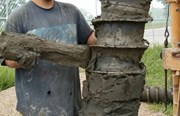
In situ soil mixing has become a preferred approach for many PRB and barrier wall installations, especially where access, groundwater conditions, or timelines make excavation challenging. By blending reactive media for PRBs or cementitious slurry for hydraulic barriers directly into the native soil, the method creates a continuous treatment zone without removing material from the ground. This reduces handling requirements, limits disruption, and supports consistent results across variable subsurface conditions.
Advantages:
- Lower disposal and backfill costs, since native material remains in place instead of being excavated and hauled off-site.
- Minimal surface disturbance, which is ideal for constrained sites, developed areas, or locations where maintaining normal operations is important.
- Faster installation on tight schedules, with fewer dependencies on trucking, dewatering, or large staging areas.
Limitations:
- Requires specialized equipment and experienced crews, which may limit contractor availability in some regions.
- Not suitable for all soil types or contaminant profiles, especially where mixing energy cannot be maintained or where reagent distribution is difficult to achieve.
Head-to-Head Comparison
Selecting the right construction method is rarely a simple choice. Both excavation and in situ soil mixing can deliver effective PRBs and barrier walls, but their performance, cost drivers, and logistical demands differ in important ways. The table below highlights the key distinctions side by side, giving you a quick way to evaluate which approach aligns best with your site conditions, regulatory expectations, and project constraints.
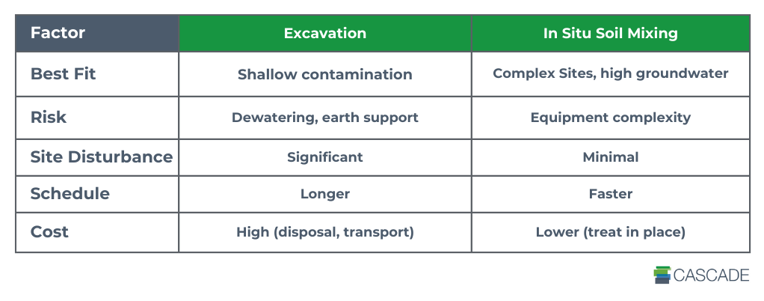
When to Choose Soil Mixing Over Excavation
Soil mixing tends to outperform excavation in many modern PRB and barrier wall applications, especially at sites where groundwater behavior, soil conditions, or project constraints introduce higher levels of risk. Because mixing keeps material in place and creates a continuous treatment zone with fewer handling requirements, it can deliver reliable performance where excavation becomes costly or disruptive. Soil mixing is often the better choice when:
- Groundwater flow is high, since excavation may require extensive dewatering, water treatment, and pumping systems. Soil mixing allows construction to proceed within saturated zones with far fewer water‑management demands.
- Soils are unstable or difficult to excavate, including loose sands, soft clays, or areas where sloping, shoring, or extra safety measures would drive up cost. Mixing stabilizes the soil mass in place, reducing the need for open excavations.
- Budgets and timelines are tight, because mixing eliminates trucking, disposal, backfill import, and large laydown areas. This creates a more predictable construction sequence with fewer logistical bottlenecks.
- Regulatory compliance requires minimal disturbance, such as at active facilities, urban sites, or sensitive ecological areas. Soil mixing keeps the surface footprint small and avoids the disruption associated with open excavations and heavy soil handling.
Common Pitfalls & How to Avoid Them
Even well-planned containment projects can run into setbacks when critical site details are overlooked or assumptions are made too early in the design process. Whether you choose excavation or soil mixing, understanding common pitfalls helps minimize risk, avoid change orders, and keep the project aligned with budget and regulatory expectations.
- Excavation: Underestimating disposal costs and incomplete delineation often lead to substantial budget overruns. When actual waste volumes exceed estimates, trucking, tipping fees, and replacement backfill can escalate quickly. Ensuring thorough characterization and conservative volume planning helps prevent mid-project surprises.
- Soil Mixing: Poor site characterization and incorrect reagent selection can reduce treatment effectiveness or cause mixing challenges in the field. Variability in soil texture, groundwater chemistry, or contaminant distribution can all impact reagent performance. Investing in bench-scale testing and confirming subsurface conditions before design helps maintain consistency and achieve the intended permeability or reactivity goals.
Want to learn more about using soil mixing for PRBs and barrier walls?
Register for our upcoming webinar: Using In Situ Soil Mixing for Permeable Reactive Barriers or Barrier Walls.
About the Author

Paul Lear, Ph.D.
Senior Technical Director, Civil & Environmental Construction
[email protected]
Paul Lear, Ph.D., a leading authority in stabilization/solidification (S/S) technology, brings over 30 years of experience in full-scale remediation projects to Cascade and is leading our efforts on ISS for PFAS remediation.
Join our newsletter

A bimonthly email with the latest expert insights in drilling and remediation